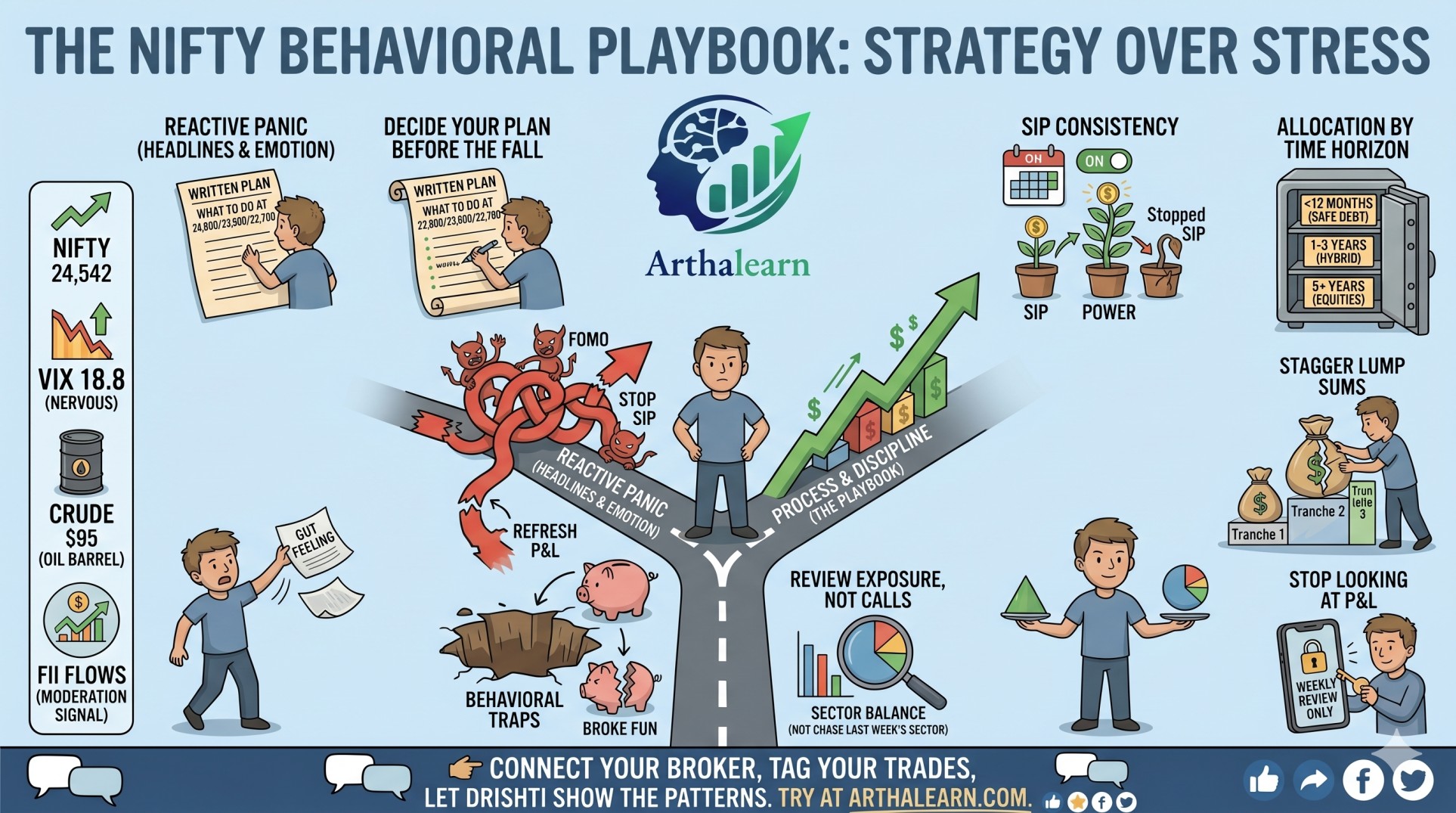
FOMO Trading — Why Indian Traders Buy at the Top (And How to Stop)
FOMO drives Indian retail traders to buy at peaks and sell at bottoms. Learn the psychology behind it, see real Indian market examples, and discover 5 proven techniques to beat FOMO for good.

FOMO isn't a character flaw — it's a wiring issue. Track it, measure it, and you can beat it.
It is 2:45 PM on an expiry Thursday. BankNifty has rallied 600 points in the last hour. Your watchlist is green. Twitter — sorry, X — is full of screenshots showing 500% returns on call options. Your finger hovers over the Buy button. "If I just get in now, I can still catch the move."

This is FOMO — Fear Of Missing Out — and it is one of the most destructive forces in Indian retail trading. It is the reason traders buy at the top, chase rallies that are already exhausted, and turn profitable months into losing ones with a single impulsive trade.
FOMO-tagged trades have a 62% lower win rate on average compared to planned entries. Track your emotions to see the proof in your own data.
In this guide, we will break down exactly what FOMO looks like in Indian markets, why your brain is wired for it, and give you five concrete techniques to beat it. If you have ever bought a stock because everyone else was buying it, this article is for you.
What FOMO Looks Like in Indian Markets
FOMO is not an abstract concept. It has specific, recognizable patterns that repeat across every market cycle. Here are three examples that every Indian trader will recognize.
1. The Adani Rally (2022–2023)
Between April 2022 and December 2022, Adani Enterprises rose from around ₹1,800 to over ₹4,100 — a gain of more than 125%. Retail traders who had been watching from the sidelines for months could not resist any longer. Many piled in above ₹3,500, chasing momentum they had missed. When the Hindenburg report dropped in January 2023, the stock crashed over 60% in two weeks. FOMO buyers who entered near the top were holding losses of ₹2,000+ per share within days.
2. SME IPO Mania (2023–2024)
The SME IPO segment became a FOMO factory. Stocks like Elcid Investments and several micro-cap IPOs listed at 200-400% premiums. Social media was flooded with screenshots of allotment gains. Retail investors started applying to every SME IPO, ignoring fundamentals entirely. SEBI eventually had to tighten SME listing norms after dozens of these companies crashed post-listing, wiping out late entrants.
3. Expiry-Day Premium Buying
Every Thursday, thousands of retail traders buy deep out-of-the-money BankNifty options hoping for a "jackpot." They see one trader on social media turn ₹5,000 into ₹5 lakh and ignore the thousands who lost their entire premium. This is FOMO at its most concentrated — lottery-ticket trading disguised as strategy. According to SEBI data, 93% of F&O traders lose money, and expiry-day gambling is a major contributor.
The Psychology Behind FOMO — Why Your Brain Betrays You
FOMO is not a character flaw. It is a deeply wired survival instinct that evolved over millions of years. Understanding the neuroscience helps you fight it.
Your amygdala — the brain's threat-detection center — fires when it perceives social exclusion. In our ancestral environment, being left out of the group meant death. When you see other traders making money and you are not, your brain interprets this as a survival threat. The resulting emotional response is identical to physical pain.
Three cognitive biases amplify FOMO:
Herd instinct — We evolved to follow the crowd. When everyone is buying, staying out feels dangerous. But in markets, the crowd is usually wrong at extremes.
Loss aversion — Research by Kahneman and Tversky shows that the pain of missing a gain is psychologically twice as intense as the pleasure of capturing one. This is why FOMO feels so urgent. Read more about loss aversion in trading.
Recency bias — We overweight recent events. A stock that has gone up for 5 straight days feels like it will go up forever, even though mean reversion is a statistical reality.
What the Data Says — SEBI on Retail Losses
SEBI's landmark study on retail participation in F&O markets (published September 2024) provides hard numbers:
93% of individual F&O traders incurred net losses over a 3-year period (FY22–FY24)
The average loss per trader was approximately ₹2 lakh per year
Transaction costs (brokerage, STT, GST, exchange fees) accounted for 28% of total losses — meaning overtrading driven by FOMO directly compounds losses
Only 1% of traders earned more than ₹1 lakh in profit per year
While SEBI does not tag "FOMO" specifically, the pattern is clear: traders who trade more frequently, chase momentum, and enter without a plan lose more. ArthaLearn users who tag their trades with emotion labels report that FOMO-tagged entries have a 62% lower win rate than planned, rules-based entries.
5 Proven Techniques to Beat FOMO
Knowing that FOMO is a brain-wiring issue is the first step. Here are five actionable techniques that traders use to override it.
1. The Pre-Trade Checklist
Before every trade, run through a written checklist. This forces your prefrontal cortex to engage before your amygdala acts. Your checklist should include:
Does this setup match my trading plan?
Is the risk-to-reward ratio at least 1:2?
Am I entering because of analysis or because of emotion?
What is my stop-loss before I enter?
If the answer to "Am I entering because of emotion?" is yes — do not take the trade. Period. Building trading discipline starts with this single habit.
2. Position Sizing Rules
FOMO trades are almost always oversized. The trader thinks: "This is THE move, I need to go big." Implement hard position sizing rules: never risk more than 1-2% of your capital on any single trade. When you know the maximum you can lose is ₹5,000 on a ₹2.5L account, the emotional intensity drops dramatically.
3. Journal Your Emotions — Every Single Trade
In your trading journal, tag every trade with the emotion you felt at the time of entry: Planned, FOMO, Revenge, Boredom, Confidence. After 50 trades, filter by tag and compare win rates. The data will shock you. ArthaLearn's emotion tagging system makes this automatic — you select the tag, and the analytics dashboard shows you the pattern.
4. The Wait-for-Pullback Rule
If you missed the initial move, do not chase. Instead, set an alert for a pullback to a key support level (20 EMA, previous resistance turned support, VWAP). If the stock is truly strong, it will pull back and give you a better entry. If it does not pull back — it was not your trade. There will always be another setup tomorrow.
5. Social Media Detox During Market Hours
Twitter/X, Telegram groups, and YouTube live streams are FOMO amplifiers. Every screenshot of a winning trade triggers your amygdala. During market hours (9:15 AM to 3:30 PM), close all social media. Check your trading plan, execute your setups, and review results after market close. This single change has been reported by ArthaLearn users as the #1 most effective FOMO reducer.
How ArthaLearn Detects FOMO Patterns
ArthaLearn is built specifically to help Indian traders identify and fix behavioral patterns like FOMO. Here is how:
Emotion tags — Tag every trade entry with your emotional state. Over time, your portfolio analytics reveals which emotions cost you money.
Entry timing analysis — ArthaLearn flags trades entered after a significant move (e.g., buying after a 3%+ rally), which are statistically more likely to be FOMO-driven.
Trade frequency alerts — If you exceed your planned number of trades per day, ArthaLearn warns you. Overtrading and FOMO are deeply linked.
ArthaLearn's AI insights — ArthaLearn's AI, our AI trading assistant, analyzes your trade history and surfaces patterns like "Your win rate drops 40% on trades entered after 2 PM" — the kind of insight that reveals FOMO tendencies.
FOMO vs. Planned Entries — The Numbers
Here is what the data shows when we compare FOMO-tagged trades versus planned entries across ArthaLearn users:
Win rate: Planned entries 58% | FOMO entries 22%
Average risk-reward: Planned 1:2.1 | FOMO 1:0.8
Average holding time: Planned 45 min | FOMO 12 min
Position size: Planned 1.5% of capital | FOMO 4.2% of capital
The pattern is unmistakable. FOMO trades are bigger, shorter, and far less profitable. They are emotional reactions, not strategic decisions.
The Bottom Line
FOMO is not a character flaw — it is a biological response that evolved to keep you alive in the savannah, not profitable in the markets. The good news is that it is measurable, predictable, and beatable.
Start by tracking your emotions in every trade. Use a pre-trade checklist. Size your positions properly. Wait for pullbacks. And turn off social media during market hours.
The traders who survive long enough to become profitable are not the ones who catch every move. They are the ones who learn to sit on their hands when FOMO screams "Buy now!" Understanding your cognitive biases is the first step toward real trading discipline.
The best trade is often no trade at all. The market will be open tomorrow.
Ready to track your FOMO patterns? Start your ArthaLearn journal today — it is free for 7 days.
Enjoyed this article?
ArthaLearn is more than articles. Log your trades, get AI-powered analysis, and track your improvement over time — built for Indian traders.
Free forever for trade logging. AI features start at ₹599/month.